Limb lengthening with PRECICE intramedullary nails - a case study
The magnetic nails used at the Paley European Institute, combined with a unique minimally invasive surgical technique, allow for significant reductions during lengthening:
- pain complaints,
- infections,
- deformities,
- total number of surgical procedures,
- wound healing time, and bone healing time.
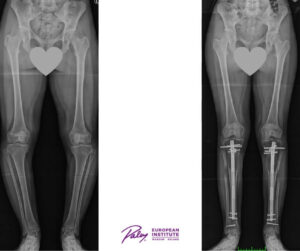
Doctors and Patients agree that Precice achieves a higher level of Patient satisfaction by increasing the quality of life during limb lengthening. The method is reproducible and, in our hands, safe. Over the past year, we have achieved more than 8 cm in bone in 16 patients. Below is an X-ray photo of one of them.
Deformity correction with the PRECICE nail
In the course of nail implantation, we also very often correct lower limb deformities, for example, sub-leg talus including obtaining more than 5 cm of new bone.
The implant is available in several diameters and lengths, selected to suit the patient's individual anatomy. It also determines the lengthening time with the help of an external ERC controller (a small device that activates the nail from the outside), which allows adjustments of 0.001mm/day.
What limb lengthening with the PRECICE nail is all about
Lengthening involves the use of osteogenesis, which is the formation of bone where it is cut. In this process, the body can produce so-called bone regenerate. At the end of the operation, the surgeon activates the implant, enabling lengthening. The technique itself involves making small incisions and creating a small hole at the end of the bone to implant a Precice nail.
See other entries
How to Properly Care for a Stump After Amputation? A Practical Guide

Hollow Foot – Symptoms, Causes, and Treatment Options