Custom-made MoonSteps orthotic insoles at the Paley European Institute
At the Paley European Institute, we help you choose solutions that can support the biomechanics of walking, reduce strain, and improve comfort while moving.
Moonsteps insoles are custom-designed orthotic insoles that we create in collaboration with OPSA—tailored to your foot, lifestyle, and therapeutic recommendations.
Orthotic insoles—what are they and how do they work?
Orthotic insoles are special inserts placed inside shoes that help redistribute pressure on the foot, support the longitudinal and transverse arches, and improve the foot’s biomechanics while standing and walking. They can relieve pressure, help reduce calluses, corns, and discomfort resulting from excessive strain on the forefoot or heel. They are used for both children and adults—for various foot types, including flat feet, high arches, excessive pronation, or asymmetrical weight distribution on the limbs.
The effectiveness of orthotics depends on the quality of the fit, the nature of the problem, and whether they are part of a well-planned treatment plan. In many cases, we combine them with exercises, physical therapy, and properly fitted footwear, but for some patients, simply changing the way their feet are supported provides real assistance in their daily activities—especially when it is difficult to maintain a regular exercise routine.
Why should you consider orthotic insoles?
They can help reduce foot pain caused by overuse or improper weight distribution.
They support the arch of the foot and stabilize its position inside the shoe, which can improve comfort while walking and standing.
In certain patients, they may improve functional parameters such as balance and postural control, especially when combined with appropriate exercises.
They allow you to customize foot support based on age, body type, activity level, and underlying medical conditions—from children to highly physically active individuals.
As part of a comprehensive treatment plan, they help protect the foot from further strain and make it easier to follow the physical therapist’s recommendations.
They are a practical option for people who are unable or unwilling to exercise regularly but want to improve their comfort and safety when moving around.

When should you consider insoles?
Insoles can be helpful for patients with foot pain caused by overuse, flexible flat feet, hollow feet, excessive pronation, uneven weight distribution, or rapid fatigue while walking. They are also effective for forefoot pain, heel pain, recurring corns, and difficulties finding comfortable footwear.
We also often consider them for conditions higher up in the kinetic chain—such as knee, hip, or back pain—when these are caused by improper foot function, as well as for lower limb alignment issues, such as knock-knees or bowlegs. For many patients, the primary goal is improved function, stability, and comfort while walking, rather than merely changing the appearance of the foot.
For children, it is essential to support proper foot function, comfort, and gait mechanics. Not every case of flat feet requires treatment with orthotics—we make the decision to use them only after a specialist examination and a discussion of the symptoms and the family’s expectations.
Who can really benefit from insoles?
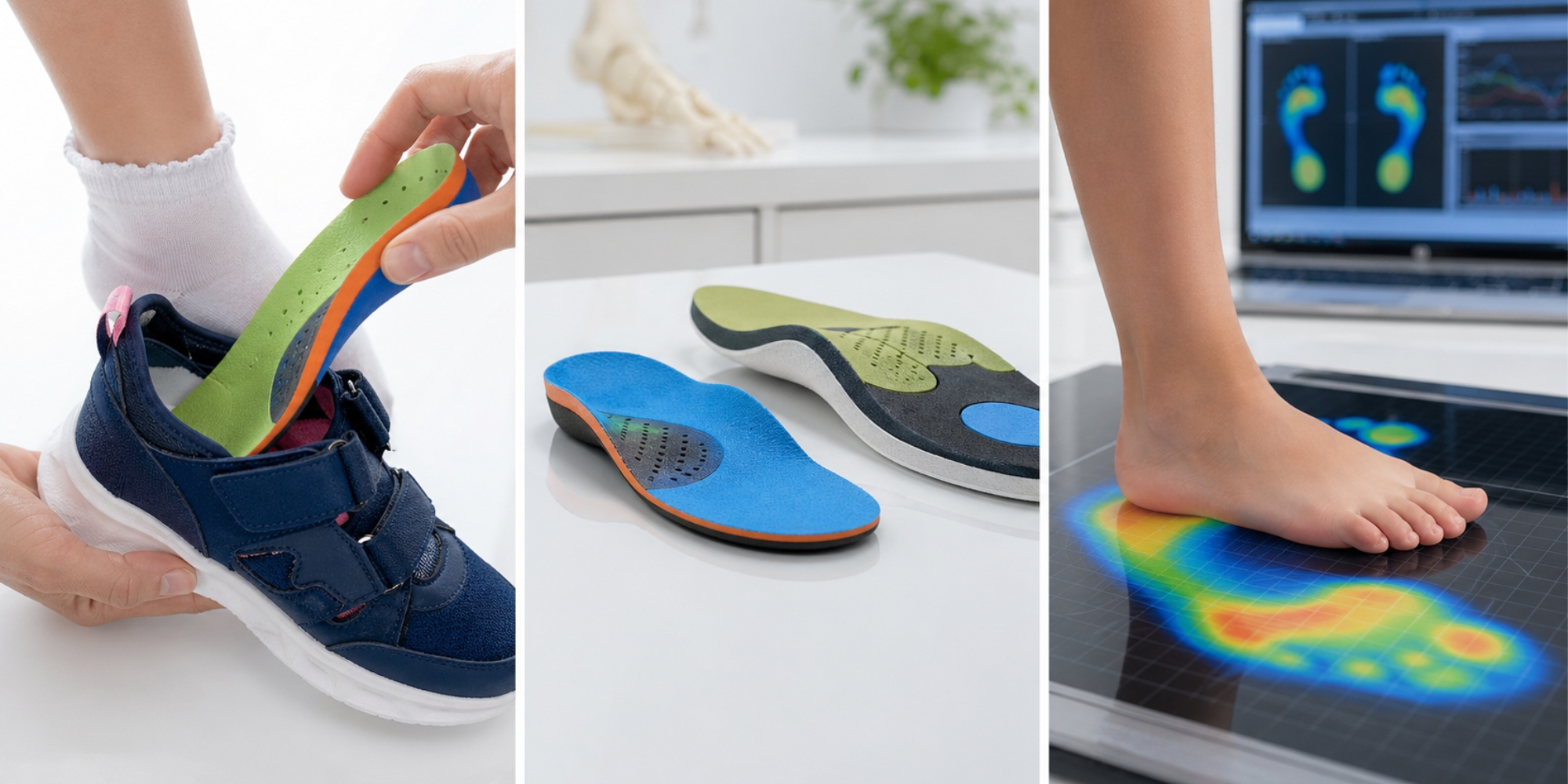
Orthotic insoles are not intended for every foot “just in case.” We primarily consider their use for patients who experience symptoms—such as pain, fatigue, overuse, or functional disorders—and for whom an examination confirms that customized foot support can improve comfort and mobility.
For whom?
For children with symptomatic flexible flat feet, when the condition is associated with pain, rapid fatigue, or a reluctance to walk or engage in physical activity.
For children and adults with overuse pain in the feet, heels, or forefoot (e.g., due to heel spurs, hollow foot, or Morton’s neuroma) associated with prolonged standing, walking, or intense physical activity.
For patients with excessive foot pronation, which affects walking comfort and can put strain on the knees, hips, or spine.
For people with uneven weight distribution in the limbs, limb length discrepancies, or foot deformities that require pressure relief in specific areas.
For athletes and highly active individuals, for whom custom insoles help distribute pressure more evenly, improve stability, and reduce the risk of certain overuse injuries.
For patients who, despite following the recommended exercises, still experience discomfort and need constant, daily support for their feet while wearing shoes.

MoonSteps insoles for athletes and office workers
Your feet work hard—whether you spend your day on the field or at the computer. We design Moonsteps insoles with two groups in mind whose daily activities place extremely different demands on their feet.
For athletes – improved foot function during exercise: Whether running, playing soccer, or doing strength training, the foot absorbs several times the body’s weight with every step. Custom-fitted MoonSteps insoles help distribute the load more evenly, reduce the risk of overloading the Achilles tendon, plantar fascia, and knee joint, and stabilize the foot’s position in athletic shoes. We select them based on the sport, type of footwear, and individual biomechanics of walking or running.
For desk workers – support during long hours of sitting and standing: Sitting at work doesn’t mean your feet are idle – long hours in one position, stiff shoes during meetings, or standing at your desk are real sources of strain on your feet, knees, and spine. MoonSteps insoles help reduce foot fatigue, improve comfort in everyday urban footwear, and relieve pressure on the heel and forefoot throughout the workday.
No matter how much you move throughout the day—your custom MoonSteps insole is designed specifically for you, not for the “average foot.” We conduct a diagnostic assessment using a 3D foot scanner and a pressure-sensing mat to ensure the insole really works.
What does the research say about insoles?
Scientific reviews emphasize that insoles can influence certain functional parameters—such as pain, foot posture, pressure distribution, and balance—but the effect depends on the patient’s age, the type of insole, the diagnosis, and the treatment approach. That is why at the Paley European Institute, we tailor treatment plans to each individual patient rather than applying a one-size-fits-all approach.
Insoles
They can reduce pain, improve pressure distribution, and enhance walking comfort—especially during prolonged standing and walking.
Some studies have reported improvements in subjective comfort and selected gait parameters among patients using custom-fitted insoles.
Foot exercises
They strengthen the muscles that stabilize the arch, improve movement control, and enhance awareness of foot positioning.
In many scientific studies, exercises have shown comparable—and sometimes greater—improvements in selected parameters than insoles alone, particularly in children with flexible flat feet.
Comprehensive therapy
Combining orthotics with exercises and footwear education may yield better results than individual interventions.
At the Paley European Institute, we strive to ensure that treatment holistically supports foot function and comfort of movement, rather than merely altering the foot’s appearance in photographs.
How do we work with inserts?
We combine the experience of the Paley European Institute team with OPSA’s expertise in the design and fabrication of custom orthotics. As a result, patients receive not only a diagnosis and recommendations, but also precisely crafted orthotics tailored to their feet, lifestyle, and therapeutic recommendations.
Accurate diagnosis
We begin with a detailed assessment of your feet, gait, posture, and reported symptoms.
We use a physical examination, 3D foot scanner analysis, plantography, and a pressure mat to assess how pressure is distributed and how the patient distributes weight on their feet.
This allows us to determine whether insoles are necessary and what role they should play—whether to relieve pressure, provide stability, or serve a more corrective purpose.
Custom fit
We select the type of insoles based on age, foot structure, type of activity, and the goal of the therapy, taking into account the shoes in which the insoles will be worn.
The insoles are designed in collaboration with the OPSA team and, if necessary, can be modified as the child grows or as their condition changes—in which case we prepare a new printout in accordance with the current recommendations.
3D Printing Technology
Moonsteps insoles are manufactured using 3D printing technology, which allows for a precise reproduction of the individual foot’s geometry and the achievement of parameters that are impossible to attain using traditional methods.
When necessary—for example, as the child grows or if their condition changes—we prepare a new printout in accordance with the current recommendations.
Rehabilitation and exercise
If necessary, we supplement the treatment with an exercise program for the feet and lower limbs, which supports the effectiveness of the insoles and improves the strength of the muscles that stabilize the arch.
At the same time, we take the patient’s actual capabilities into account—for some people, orthotics provide the main source of daily support, especially when exercises are performed irregularly.
Monitoring the results
We schedule regular follow-up visits to assess comfort, function, and the effectiveness of the treatment, and to make any necessary adjustments to the insoles or exercise program.
This prevents a situation where a patient wears insoles for years without any real benefit, and ensures that the treatment plan remains tailored to their needs.
Long-term care
Orthotic fitting is a process, not a one-time event. We stay in touch with the patient and their caregivers, monitoring progress and responding to changing needs.
The goal is not only to correct the problem, but also to bring about a lasting improvement in comfort, posture, and quality of life at every stage.

Our partners – MoonSteps and OPSA
MoonSteps insoles are the result of a collaboration between the Paley European Institute and experienced specialists in the field of orthotics. We combine clinical diagnosis with precision craftsmanship—so that every insole is not only well-fitted but also well-made.

Moonsteps is a brand of orthotic insoles developed by OPSA. Each Moonsteps insole is custom-made based on an individual assessment—taking into account the patient’s foot structure, lifestyle, symptoms, and type of footwear.
The Moonsteps name and brand refer to insoles that aren’t just “off-the-shelf products”—they are precisely engineered to support your feet, based on real data from research conducted at the Paley European Institute.

OPSA (Orthotic and Prosthetic Specialists Association) is an elite team of prosthetists, orthotists, and engineers who specialize in the design and fabrication of orthopedic devices—orthoses, prostheses, and custom insoles. The OPSA team combines many years of clinical experience with state-of-the-art manufacturing technology.
In collaboration with the Paley European Institute, we provide Moonsteps orthotics—from foot scanning and design all the way to the final product tailored to therapeutic recommendations. The design of each orthotic can be updated as therapy progresses, the child grows, or symptoms change.
Frequently Asked Questions About Insoles
Sometimes that’s true, but in many cases—especially with flat feet—the best results come from combining insoles with exercises, proper footwear, and physical therapy that addresses the root cause of the problem. It’s also important to remember that not every patient will exercise regularly, which is why custom insoles often provide important, practical support that improves foot alignment and walking comfort.
The most important factors are comfort, the absence of severe pain, and gradually getting used to the insoles. The first orthopedic follow-up appointment usually takes place after about 4 months of use to assess the results of the treatment and make adjustments if necessary.
No. Some insoles are designed to provide support, relieve pressure, or stabilize the foot, rather than strictly correcting it. We select the type of insole based on specific clinical indications and treatment goals, which are determined in consultation with the patient and their family.
We recommend regular checkups and contacting us immediately if you experience new pain, blisters, or significant discomfort. For children, checkups are necessary, for example, when their shoe size changes or they experience a growth spurt.
The duration of therapy varies from person to person. We do not recommend wearing the insoles indefinitely without follow-up visits. The decision to continue or discontinue therapy is made by a specialist based on an assessment of function, symptoms, and treatment goals.